Key Points
- The median dentist salary was $176,110 a year, or $84.67 an hour, in May 2025 (BLS). The mean was $202,280, and general dentists earned a median of $170,950.
- The top 10% of dentists earned more than $337,210, and the lowest 10% earned less than $89,100.
- Specialty creates the widest pay gaps in BLS data. Oral and maxillofacial surgeons earned a median of $352,220, about twice the general dentist median.
- Ownership raises the ceiling. In 2025, general dentists who owned their practices averaged $228,980 in net income, compared with $164,510 for employed general dentists (ADA Health Policy Institute).
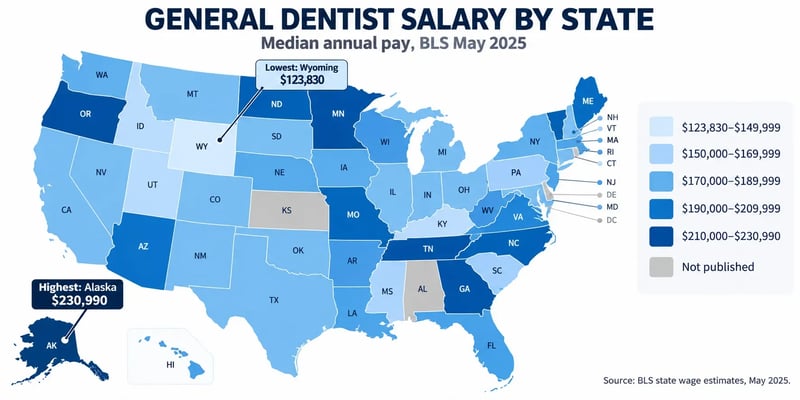
- Among general dentists, Alaska paid the highest state median at $230,990 and Wyoming the lowest at $123,830.

Average Annual Pay for Dentists
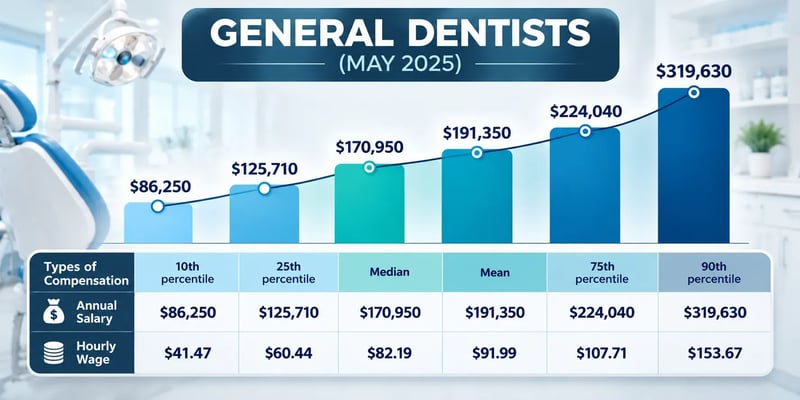
According to the BLS Occupational Outlook Handbook, the median annual wage for dentists was $176,110 in May 2025. BLS's national wage tables put the mean, the arithmetic average, at $202,280. General dentists, who hold about 88% of the dentist jobs in BLS wage data, earned a median of $170,950 and a mean of $191,350.
The American Dental Association's Health Policy Institute (ADA HPI) measures pay a different way. Its Survey of Dental Practice, covering 2025, found that dentists in private practice averaged $241,250 in net income. General dentists averaged $215,320 and specialists $346,520, with medians of $185,010 and $258,880.
The ADA figures run higher mainly for two reasons. The survey includes owners of unincorporated practices, whom BLS leaves out along with other self-employed dentists, and it counts year-end bonuses and retirement plan payments, which BLS excludes. The two sources also cover different dentists: the ADA surveys only private practice, while BLS also counts dentists in government, education and hospital jobs. Because the ADA results rest on 1,113 survey responses, a 1.9% response rate, they work best as a second view alongside BLS rather than a replacement for it.
Dentist Hourly Wage
The median dentist hourly wage was $84.67 in May 2025, and the mean was $97.25. General dentists earned a median of $82.19 an hour. BLS converts between hourly and annual pay using 2,080 hours, a 40-hour week for 52 weeks, as its survey methodology explains, so $84.67 times 2,080 works out to the $176,110 annual median.
Many dentists don't work that many hours. BLS notes that "many dentists work less than 40 hours a week," and ADA HPI found that general dentists in private practice spent about 1,690 hours in the office in 2025. Dividing their $215,320 average net income by those hours works out to roughly $127 per office hour, about $133 for owners and $108 for employed dentists.
BLS's household survey offers a separate, weekly view of dentist pay. Full-time dentists on a payroll had median weekly earnings of $3,293 in 2025, or about $171,200 over 52 weeks.
Median vs. Mean Dentist Salary
The mean dentist salary was $202,280 in May 2025, $26,170 higher than the $176,110 median, because a smaller group of very high earners pulls the average up. The median is the middle dentist, with half earning more and half earning less, while the mean adds up every dentist's pay and divides by the number of dentists.
Among general dentists, the gap was $20,400 ($191,350 vs. $170,950). ADA HPI's private-practice data show the same pattern, with general dentists averaging $215,320 in 2025 net income against a median of $185,010.
For a sense of what a typical dentist earns, the median is the better number. The mean is useful mainly when you're comparing against a source that reports averages, so it's worth checking which figure a salary claim uses before setting it next to another. A summary that pairs one group's median with another group's mean can overstate what a typical dentist makes.
In BLS wage data, the pattern flips in the three highest-paid specialties. Oral and maxillofacial surgeons had a mean of $346,490 against a median of $352,220, orthodontists $259,400 against $289,140, and prosthodontists $268,630 against $311,180. In those fields the middle of the pay scale is already high, and the lower end pulls the average below it.
The percentile ladder below shows where general dentist pay falls, from the lowest 10% to the top 10%. The percentiles are BLS's May 2025 figures as published by O*NET, and the mean comes from BLS's national wage tables.
Top 10% Earners
The top 10% of dentists earned more than $337,210 in May 2025. Among general dentists, the cutoff was $319,630, nearly twice the general dentist median. BLS reports the 90th percentile as a threshold, so it marks where the top group starts rather than what its members average.
Specialists are overrepresented in that top group. Oral and maxillofacial surgeons had the highest median of any dentists at $352,220, which means half of them earned more than the top-10% cutoff for general dentists. Prosthodontists ($311,180) and orthodontists ($289,140) followed, and the top 10% of dentists in BLS's "all other specialists" group earned more than $402,700.
Location shapes the top end, too. Among general dentists, the 90th percentile topped $400,000 in three states, Missouri ($427,970), Massachusetts ($417,670) and Hawaii ($416,000), with Maine ($385,460), New York ($375,740) and Georgia ($373,420) next.
Ownership is another route to the top. ADA HPI's 2025 data show that specialists who own their practices averaged $372,460 in net income, and the top quarter of them netted more than $436,420. Among general dentists who own their practices, the top quarter netted more than $295,370.
Do Dentists Make 300K?
Some do, but $300,000 places a general dentist near the top of the profession. A general dentist earning $300,000 makes more than at least three in four peers, since the 75th percentile was $224,040 in May 2025, and sits just under the $319,630 cutoff for the top 10%. The figure is more common among specialists: half of oral and maxillofacial surgeons earn more than $352,220, and the prosthodontist median of $311,180 is also above $300,000.
Lowest 10% Earners
The lowest-paid 10% of dentists earned less than $89,100 in May 2025. Among general dentists, the cutoff was $86,250, about half the general dentist median, and the next step up the ladder is much higher, with the 25th percentile at $125,710.
BLS figures are pay rates, not yearly earnings: employers report part-time dentists' hourly rates, and BLS converts every rate to a 2,080-hour year. So the bottom 10% marks dentists with low pay rates, and a part-time dentist's actual income for the year can be lower than the BLS annual figure suggests.
Several groups tend to earn less than the typical dentist:
- Early-career associates. In ADEA's survey of the Class of 2025, 77% of seniors heading into private practice expected to start as associates, and ADA HPI estimates that general dentists average $171,062 in net income five years after graduation, well below the $215,320 average for all general dentists in private practice.
- Employed dentists. Employed general dentists had a median net income of $165,520 in 2025, and a quarter of them netted less than $129,280 (ADA HPI).
- Struggling solo practices. Ownership doesn't guarantee more money. The bottom quarter of solo general dentist owners netted less than $115,200 in 2025, below the same cutoff for employed dentists.
- Dentists in lower-paying states. General dentist medians were lowest in Wyoming ($123,830), Idaho ($124,190), Utah ($133,320), Kentucky ($134,160) and Mississippi ($143,660).
Dentists in residency training can earn far less. The VA's general practice residency in Wilkes-Barre, Pennsylvania, for example, listed a $58,000 stipend for its first-year residents in 2024. That pay arrives alongside large loan balances, too: graduates in the Class of 2025 who had education debt owed an average of $297,800, according to ADEA.
What Separates High and Low Earners
BLS sums up the main factors in one line: "Wages vary with the dentist's location, number of hours worked, specialty, and number of years in practice." Practice ownership and work setting belong on that list as well, and the gaps these factors create range from tens of thousands of dollars to more than $100,000.
Specialty
Specialty produces the widest gaps in BLS pay data. Oral and maxillofacial surgeons earned a median about twice the general dentist median in May 2025, and every specialty group BLS tracks out-earned general dentists at the median.
That pay comes with more training. Most specialties require a 2- to 4-year residency after dental school, and oral and maxillofacial surgery programs typically take 4 to 6 years, while general dentists need no training beyond dental school (BLS). The "all other specialists" group covers specialties BLS doesn't list separately, and our guide to the different types of dentists explains what each specialty does. The same gap shows up in private practice, where ADA HPI found that specialists averaged $346,520 in 2025 net income against $215,320 for general dentists.
Practice Ownership
Owning a practice raises a dentist's ceiling more than the floor. In ADA HPI's 2025 data, general dentists who owned their practices averaged $228,980 in net income, compared with $164,510 for employed general dentists. The bottom quarter of owners netted less than $137,010, close to the $129,280 cutoff for employed dentists, while the top quarter netted more than $295,370, against $191,470 for employed dentists.
Owners who practice with at least one other dentist (ADA's "nonsolo" owners) earned the most among general dentists. Among general dentists, solo owners showed the widest range: the bottom quarter netted less than $115,200 in 2025, while the top quarter netted more than $270,210. The employed figures rest on 65 survey responses, so treat them as approximate.
Fewer dentists own practices than a generation ago. ADA HPI's workforce report found that 73% of dentists were practice owners in 2023, down from 85% in 2005, while the share affiliated with a dental support organization (DSO) more than doubled from 7.2% in 2015 to 16.1% in 2024. Ownership also comes later in a career. ADA News reported that 21% of 2016 to 2020 graduates owned a practice three to seven years out, compared with 63% to 70% of dentists who graduated in 2010 or earlier at a comparable early-career stage.
For employed dentists, pay depends on how the contract is written. The ADA's guide to dentist compensation describes four models: a straight salary, a salary plus commission, a straight commission on production or collections, and net-profit pay, based on the dentist's billings minus expenses set in the contract. Its worked examples pay associates 30% to 35% of production or collections, and the ADA notes elsewhere that some practices offer a daily guarantee. BLS counts commissions and production bonuses as wages, so production-based pay is part of the BLS figures.
Dentist Salary by State
The dentist salary by state ranges from a general dentist median of $230,990 in Alaska to $123,830 in Wyoming. Ten states had medians above $200,000 in May 2025, led by Alaska, North Dakota ($220,660), Minnesota ($219,200), Tennessee ($215,290) and Oregon ($211,690).
None of the largest markets makes the top 10. California, which has the most general dentist jobs (16,770), ranks 33rd at $165,950, while New York pays $183,060, Florida $174,900 and Texas $162,360. Metro areas vary even more: among metros with at least 1,000 general dentist jobs, Atlanta ($222,690), Minneapolis-St. Paul ($219,980) and Nashville ($215,290) had the highest medians, while Los Angeles ($139,990) was among the lowest.
The table shows each state's general dentist median and the level the top 10% earn above, from BLS's May 2025 state data.
BLS did not publish May 2025 general dentist wage estimates for Alabama, Delaware, the District of Columbia or Kansas. State figures rest on smaller samples than the national data, so a few look unusual, such as Minnesota's top-10% cutoff ($226,940) sitting only slightly above its median.